
La population de l’Afrique du Sud compte environ 60,1 millions de personnes d’origines, de cultures, de langues et de religions diverses. [1] [2] Le recensement national sud-africain de 2011 était le plus récent tenu; la prochaine aura lieu en 2022. [4]
| Démographie de l’Afrique du Sud | |
|---|---|
 Pyramide des âges de l’Afrique du Sud en 2020 Pyramide des âges de l’Afrique du Sud en 2020 |
|
| Population | 58 775 022 (estimation 2019) [1] |
| Densité | 48,1/km2 |
| Taux de croissance | 1,43 % [2] |
| Taux de natalité | 21 naissances/1 000 habitants (2018) [3] |
| Taux de mortalité | 9 décès/1 000 habitants (2018) [3] |
| Espérance de vie | 64,7 ans (est. 2019) |
| • Masculin | 61,5 ans (estimation 2019) |
| • femelle | 67,5 ans (estimation 2019) |
| Taux de fécondité | 2,32 enfants nés / femme (est. 2019) |
| Taux de mortalité infantile | 22,1 décès/1 000 (estimation 2019) |
| Pyramide des ages | |
| 0–14 ans | 28,8 % (estimation 2019) |
| 15–64 ans | 65,2% (estimation 2019) |
| 65 ans et plus | 6% (estimation 2019) |
| Sex-ratio | |
| Total | 0,99 homme(s)/femme (est. 2010) |
| À la naissance | 1.02 homme(s)/femme |
| Moins de 15 ans | 1 mâle(s)/femelle |
| 15–64 ans | 1.02 homme(s)/femme |
| 65 ans et plus | 0,68 homme(s)/femme |
| Nationalité | |
| Nationalité | Sud africain |
| Langue | |
| Officiel | Voir Langues d’Afrique du Sud |
 Densité de population en Afrique du Sud (couleur plus foncée = densité plus élevée)
En 2011, Statistics South Africa comptait 2,1 millions d’étrangers au total. [5] Les rapports [ préciser ] suggèrent qu’il s’agit d’une sous-estimation. Le chiffre réel pourrait atteindre cinq millions, [6] dont quelque trois millions de Zimbabwéens . [7]
Histoire
 Population historique de l’Afrique du Sud
| Apprendre encore plus Cette section a besoin d’être agrandie . Vous pouvez aider en y ajoutant . ( janvier 2022 ) |
Population
Recensements
Numéros du recensement national de 1904 à 1985
Les données démographiques des bantoustans ont été supprimées des données de recensement sud-africaines pendant l’apartheid et, pour cette raison, les chiffres officiels sur la population nationale du pays pendant cette période seront inexacts. [8]
| An | Blancs | Colorés | Asiatiques | Noirs | Total |
|---|---|---|---|---|---|
| 1904 | 1 117 | 445 | 122 | 3 490 | 5 174 |
| 1911 | 1 276 | 525 | 152 | 4 019 | 5 972 |
| 1921 | 1 521 | 545 | 163 | 4 697 | 6 926 |
| 1936 | 2 003 | 769 | 220 | 6 596 | 9 588 |
| 1946 | 2 372 | 928 | 285 | 7 830 | 11 415 |
| 1951 | 2 642 | 1 103 | 367 | 8 560 | 12.672 |
| 1960 | 3 088 | 1 509 | 477 | 10 928 | 16 002 |
| 1970 (1) | 3 773 | 2 051 | 630 | 15 340 | 21 794 |
| 1970 (2) | 3 759 | 2 039 | 630 | 11 891 | 18 319 |
| 1980 (1) | 4 221 | 2 459 | 748 | 13 135 | 20 563 |
| 1980 (2) | 4 512 | 2 688 | 803 | 16 992 | 24 995 |
| 1985 (1) | 4 569 | 2 833 | 821 | 15 163 | 23 386 |
| 1985 (2) | 4 837 | 2 396 | 879 | 19 052 | 27 704 |
Recensement de 1904
Chiffres de la population sud-africaine pour le recensement de 1904. Provenance : [9]
| Colonie Populaire. Grouper | Colonie du Cap | Natal | Transvaal | Colonie de la rivière Orange | Total | Pour cent |
|---|---|---|---|---|---|---|
| africain | 1 424 787 | 904 041 | 937 127 | 225 101 | 3 491 056 | 67,5 % |
| Blanc | 579 741 | 97 109 | 297 277 | 142 690 | 1 116 805 | 21,6 % |
| Coloré | 395 034 | 6 686 | 24 226 | 19 282 | 445 228 | 8,6 % |
| Indien | 10 242 | 100 918 | 11 321 | 253 | 122 734 | 2,4 % |
| Total | 2 409 804 | 1 108 754 | 1 269 951 | 387 315 | 5 175 463 | 100,0 % |
| % de l’Afrique du Sud | 46,6 % | 21,4 % | 24,5 % | 7,5 % | 100% |
Recensement de 1960
Sources : Annuaire de l’homme d’État 1967-1968 ; [10] Annuaire Europa 1969 [11]
| Province Populaire. Grouper | Cap de Bonne Espérance |
Natal | Transvaal | État libre d’ Orange | Total | Pour cent |
|---|---|---|---|---|---|---|
| africain | 3 011 080 | 2 199 920 | 4 633 378 | 1 083 886 | 10 928 264 | 68,3 % |
| Blanc | 1 003 207 | 340 235 | 1 468 305 | 276 745 | 3 088 492 | 19,3 % |
| Coloré | 1 330 089 | 45 253 | 108 007 | 25 909 | 1 509 258 | 9,4 % |
| Indien | 18 477 | 394 854 | 63 787 | 7 | 477 125 | 3,0 % |
| Total | 5 362 853 | 2 980 262 | 6 273 477 | 1 386 547 | 16 003 139 | 100,0 % |
| % de l’Afrique du Sud | 33,5 % | 18,6 % | 39,2 % | 8,7 % | 100,0 % |
Recensement de 1996
Source : Le peuple d’Afrique du Sud : Recensement de la population, 1996 [12]
| Province Populaire. Grouper | cap Oriental | État libre | Gauteng | KwaZulu-Natal | Mpumalanga | Cap Nord | Province du Nord | Nord Ouest | Cape de Western | Total | Pour cent |
|---|---|---|---|---|---|---|---|---|---|---|---|
| africain | 5 448 495 | 2 223 940 | 5 147 444 | 6 880 652 | 2 497 834 | 278 633 | 4 765 255 | 3 058 686 | 826 691 | 31 127 631 | 76,7 % |
| Blanc | 330 294 | 316 459 | 1 702 343 | 558 182 | 253 392 | 111 844 | 117 878 | 222 755 | 821 551 | 4 434 697 | 10,9 % |
| Coloré | 468 532 | 79 038 | 278 692 | 117 951 | 20 283 | 435 368 | 7 821 | 46 652 | 2 146 109 | 3 600 446 | 8,9 % |
| Indien / Asiatique | 19 356 | 2 805 | 161 289 | 790 813 | 13 083 | 2 268 | 5 510 | 10 097 | 40 376 | 1 045 596 | 2,6 % |
| Autre | 35 849 | 11 262 | 58 654 | 69 423 | 16 120 | 12 208 | 32 904 | 16 635 | 122 148 | 375 204 | 0,9 % |
| Total | 6 302 525 | 2 633 504 | 7 348 423 | 8 417 021 | 2 800 711 | 840 321 | 4 929 368 | 3 354 825 | 3 956 875 | 40 583 573 | 100,0 % |
| % de SA | 15,5 % | 6,5 % | 18,1 % | 20,7 % | 6,9 % | 2,1 % | 12,1 % | 8,3 % | 9,7 % | 100% |
Recensement de 2001
Source : Statistics South Africa : Recensement 2001 [13]
| Province Populaire. Grouper | cap Oriental | État libre | Gauteng | KwaZulu-Natal | Limpopo | Mpumalanga | Cap Nord | Nord Ouest | Cape de Western | Total | Pour cent |
|---|---|---|---|---|---|---|---|---|---|---|---|
| africain | 5 635 079 | 2 381 073 | 6 522 792 | 8 002 407 | 5 128 616 | 2 886 345 | 293 976 | 3 358 450 | 1 207 429 | 35 416 166 | 79,0 % |
| Blanc | 304 506 | 238 791 | 1 758 398 | 483 448 | 126 276 | 203 244 | 102 042 | 244 035 | 832 901 | 4 293 640 | 9,6 % |
| Coloré | 478 807 | 83 193 | 337 974 | 141 887 | 10 163 | 22 158 | 424 389 | 56 959 | 2 438 976 | 3 994 505 | 8,9 % |
| Indien / Asiatique | 18 372 | 3 719 | 218 015 | 798 275 | 8 587 | 11 244 | 2 320 | 9 906 | 45 030 | 1 115 467 | 2,5 % |
| Total | 6 436 763 | 2 706 775 | 8 837 178 | 9 426 017 | 5 273 642 | 3 122 990 | 822 727 | 3 669 349 | 4 524 335 | 44 819 778 | 100,0 % |
| % de SA | 14,4 % | 6,0 % | 19,7 % | 21,0 % | 11,8 % | 7,0 % | 1,8 % | 8,2 % | 10,1 % | 100% |
Recensement de 2011
Source : Recensement 2011 : Recensement en bref [14]
| Province Populaire. Grouper | cap Oriental | État libre | Gauteng | KwaZulu-Natal | Limpopo | Mpumalanga | Cap Nord | Nord Ouest | Cape de Western | Total | Pour cent |
|---|---|---|---|---|---|---|---|---|---|---|---|
| africain | 5 660 230 | 2 405 533 | 9 493 684 | 8 912 921 | 5 224 754 | 3 662 219 | 576 986 | 3 152 063 | 1 912 547 | 41 000 938 | 79,2 % |
| Coloré | 541 850 | 83 844 | 423 594 | 141 376 | 14 415 | 36 611 | 461 899 | 71 409 | 2 840 404 | 4 615 401 | 8,9 % |
| Blanc | 310 450 | 239 026 | 1 913 884 | 428 842 | 139 359 | 303 595 | 81 246 | 255 385 | 915 053 | 4 586 838 | 8,9 % |
| Indien / Asiatique | 27 929 | 10 398 | 356 574 | 756 991 | 17 881 | 27 917 | 7 827 | 20 652 | 60 761 | 1 286 930 | 2,5 % |
| Autre | 21 595 | 6 790 | 84 527 | 27 170 | 8 459 | 9 597 | 17 903 | 10 444 | 93 969 | 280 454 | 0,5 % |
| Total | 6 562 053 | 2 745 590 | 12 272 263 | 10 267 300 | 5 404 868 | 4 039 939 | 1 145 861 | 3 669 349 | 5 822 734 | 51 770 560 | 100,0 % |
| % de SA | 12,7 % | 5,3 % | 23,7 % | 19,8 % | 10,4 % | 7,8 % | 2,2 % | 7,1 % | 11,2 % | 100% | |
| An | Populaire. | ±% pa | |||||||||
| 1 | 100 000 | — | |||||||||
| 1000 | 300 000 | +0,11% | |||||||||
| 1500 | 600 000 | +0,14% | |||||||||
| 1600 | 700 000 | +0,15 % | |||||||||
| 1700 | 1 000 000 | +0,36% | |||||||||
| 1820 | 1 550 000 | +0,37% | |||||||||
| 1870 | 2 547 000 | +1,00 % | |||||||||
| 1904 | 5 175 463 | +2,11% | |||||||||
| 1911 | 5 972 757 | +2,07% | |||||||||
| 1913 | 6 153 000 | +1,50% | |||||||||
| 1921 | 6 927 403 | +1,49% | |||||||||
| 1936 | 9 587 863 | +2,19% | |||||||||
| 1946 | 11 415 925 | +1,76% | |||||||||
| 1950 | 13 683 162 | +4,63% | |||||||||
| 1955 | 15 384 557 | +2,37% | |||||||||
| 1960 | 17 396 367 | +2,49% | |||||||||
| 1970 | 22 502 502 | +2,61% | |||||||||
| 1980 | 29 077 143 | +2,60% | |||||||||
| 1990 | 36 793 490 | +2,38% | |||||||||
| 1995 | 41 426 810 | +2,40% | |||||||||
| 2001 | 44 819 777 | +1,32% | |||||||||
| 2007 | 48 502 063 | +1,32% | |||||||||
| 2011 | 51 770 560 | +1,64% | |||||||||
| 2016 | 55 653 654 | +1,46% | |||||||||
| Note : Les estimations de population (1 AD – 1870 AD) sont déduites de calculs historiques macroéconomiques quantitatifs. 1 (est.), 1000 (est.), 1500 (est.), 1600 (est.), 1700 (est.), 1820 (est.), 1870 (est.), 1913, [15] 1904 [9 ] 1904-1946, [16] [17] [18] 1950-2010, [19] 2001 , 2011 , 2015 [20] |
Projections démographiques de l’ONU : 2019 à 2100
| An | Populaire. | ±% pa |
|---|---|---|
| 2019 | 58 558 000 | — |
| 2030 | 65 956 000 | +1,09% |
| 2050 | 75 518 000 | +0,68% |
| 2100 | 79 191 000 | +0,10 % |
| Source : Secrétariat des Nations Unies [21] |
Estimations de l’âge et de la population : 1950 à 2030
Selon la révision 2019 des Perspectives de la population mondiale du Secrétariat des Nations Unies , la population totale de l’Afrique du Sud était de 55 386 000 en 2015, contre seulement 13 628 000 en 1950. En 2015, 29,3 % de la population étaient des enfants de moins de 15 ans, 65,7 % avaient entre 15 et 64 ans et 5,0 % avaient 65 ans ou plus. [22] Toutes les estimations de population sont arrondies au millier le plus proche.
| An | Population totale | Pourcentage de moins de 15 ans |
Pourcentage 15 à 64 ans |
Pourcentage d’au moins 65 ans |
|---|---|---|---|---|
| 1950 | 13 628 000 | 38.2 | 57,7 | 4.1 |
| 1955 | 15 207 000 | 39,5 | 56,5 | 3.9 |
| 1960 | 17 100 000 | 40,8 | 55,4 | 3.9 |
| 1965 | 19 385 000 | 41,9 | 54.3 | 3.8 |
| 1970 | 22 070 000 | 41,6 | 54,7 | 3.8 |
| 1975 | 25 195 000 | 41.2 | 55,0 | 3.8 |
| 1980 | 28 557 000 | 40,9 | 55.3 | 3.9 |
| 1985 | 32 679 000 | 40,8 | 55,4 | 3.9 |
| 1990 | 36 801 000 | 40.1 | 55,9 | 4.0 |
| 1995 | 41 436 000 | 37.3 | 58,4 | 4.3 |
| 2000 | 44 968 000 | 33,9 | 61,6 | 4.5 |
| 2005 | 47 881 000 | 30,9 | 64,5 | 4.6 |
| 2010 | 51 217 000 | 29,7 | 65,6 | 4.8 |
| 2015 | 55 386 000 | 29.3 | 65,7 | 5.0 |
| 2020 | 59 309 000 | 28,8 | 65,7 | 5.5 |
| 2025 | 62 803 000 | 27.4 | 66,5 | 6.1 |
| 2030 | 65 956 000 | 25,8 | 67,6 | 6.7 |
Statistiques de l’état civil
Stats SA : de 2002 à aujourd’hui
Les statistiques suivantes sont obtenues à partir des estimations de population en milieu d’année publiées par Stats SA : [23]
| Population moyenne | Naissances vivantes | Décès | Changement naturel | Taux brut de natalité (pour 1 000) | Taux brut de mortalité (pour 1 000) | Changement naturel (pour 1 000) | Taux de fécondité totale | |
|---|---|---|---|---|---|---|---|---|
| 2002 | 46 355 083 | 983 092 | 596 983 | 386 109 | 21.2 | 12.9 | 8.7 | 2,45 |
| 2003 | 46 806 354 | 991 067 | 617 135 | 373 932 | 21.2 | 13.2 | 8.0 | 2.42 |
| 2004 | 47 310 050 | 1 057 881 | 645 841 | 412 040 | 22.4 | 13.7 | 8.7 | 2.54 |
| 2005 | 47 860 360 | 1 102 207 | 673 977 | 428 230 | 23,0 | 14.1 | 8.9 | 2,59 |
| 2006 | 48 446 414 | 1 137 157 | 696 827 | 440 330 | 23,5 | 14.4 | 9.1 | 2,63 |
| 2007 | 49 088 699 | 1 171 370 | 696 160 | 475 210 | 23,9 | 14.2 | 9.7 | 2,65 |
| 2008 | 49 794 560 | 1 196 958 | 686 582 | 510 376 | 24.0 | 13.8 | 10.2 | 2,66 |
| 2009 | 50 544 931 | 1 203 604 | 643 045 | 560 559 | 23,8 | 12.7 | 11.1 | 2.62 |
| 2010 | 51 328 662 | 1 203 967 | 603 347 | 600 620 | 23,5 | 11.8 | 11.7 | 2,58 |
| 2011 | 52 129 117 | 1 192 033 | 561 381 | 630 652 | 22,9 | 10.8 | 12.1 | 2.51 |
| 2012 | 52 930 356 | 1 184 320 | 544 956 | 639 364 | 22.4 | 10.3 | 12.1 | 2.46 |
| 2013 | 53 751 095 | 1 179 957 | 535 678 | 644 279 | 22,0 | 10.0 | 12.0 | 2.42 |
| 2014 | 54 574 401 | 1 177 893 | 521 005 | 656 888 | 21.6 | 9.5 | 12.1 | 2.39 |
| 2015 | 55 406 634 | 1 167 002 | 525 739 | 641 263 | 21.1 | 9.5 | 11.6 | 2.35 |
| 2016 | 56 252 336 | 1 145 354 | 517 030 | 628 324 | 20.4 | 9.2 | 11.2 | 2.29 |
| 2017 | 57 097 857 | 1 168 092 | 515 722 | 652 370 | 20,5 | 9.0 | 11.5 | 2.33 |
| 2018 | 57 939 226 | 1 182 107 | 516 635 | 665 472 | 20.4 | 8.9 | 11.5 | 2.35 |
| 2019 | 58 775 022 | 1 178 116 | 518 613 | 659 503 | 20,0 | 8.8 | 11.2 | 2.34 |
| 2020 | 59 622 350 | 1 173 943 | 519 865 | 654 078 | 19.7 | 8.7 | 11 | 2.33 |
| 2021 | 60 142 978 | 1 166 304 | 695 913 | 470 391 | 19.4 | 11.6 | 7.8 | 2.31 |
Estimations des Nations Unies, 2019
Le Département de la population des Nations Unies a préparé les estimations suivantes. [22] (L’augmentation ou la diminution naturelle sur une période est la différence entre les naissances vivantes et les décès de cette période, avant de tenir compte de la migration entrante ou sortante.)
| Période | Naissances vivantes par an | Décès par an | Accroissement naturel par an | Taux brut de natalité (pour 1 000 par an) |
Taux brut de mortalité (pour 1 000 par an) |
Accroissement naturel (pour 1 000 par an) |
Taux de fécondité total (sur la durée de vie moyenne d’une femme) | Taux de mortalité infantile (pour 100 000 naissances vivantes) |
|---|---|---|---|---|---|---|---|---|
| 1950–1955 | 606 600 | 292 400 | + 314 200 | 42.1 | 20.7 | + 21,8 | 6.05 | 134 |
| 1955-1960 | 669 400 | 293 800 | + 375 600 | 41.4 | 18.2 | + 23,3 | 6.05 | 121 |
| 1960-1965 | 740 200 | 304 600 | + 435 600 | 40,6 | 16.7 | + 23,9 | 6.00 | 112 |
| 1965-1970 | 810 600 | 313 600 | + 497 000 | 39.1 | 15.2 | + 24,0 | 5,80 | 103 |
| 1970-1975 | 896 000 | 315 400 | + 580 600 | 37,9 | 13.3 | + 24,6 | 5,50 | 89 |
| 1975-1980 | 967 400 | 309 800 | + 657 600 | 36,0 | 11.5 | + 24,5 | 5.05 | 71 |
| 1980–1985 | 1 099 200 | 311 000 | + 788 200 | 35,9 | 10.2 | + 25,7 | 4,90 | 56 |
| 1985–1990 | 1 147 400 | 299 400 | + 848 000 | 33,0 | 8.6 | + 24,4 | 4.40 | 46 |
| 1990–1995 | 1 074 600 | 318 000 | + 756 600 | 27,5 | 8.1 | + 19,3 | 3.51 | 41 |
| 1995–2000 | 1 026 600 | 448 000 | + 578 600 | 23,8 | 10.4 | + 13,4 | 2,88 | 47 |
| 2000–2005 | 1 051 600 | 626 800 | + 424 800 | 22,7 | 13.5 | + 9,2 | 2.61 | 54 |
| 2005–2010 | 1 166 200 | 671 400 | + 494 800 | 23,5 | 13.6 | + 10,0 | 2.62 | 48 |
| 2010-2015 | 1 207 200 | 557 200 | + 650 000 | 22.6 | 10.5 | + 12,2 | 2,55 | 33 |
| 2015–2020 | 1 185 000 | 546 000 | + 639 000 | 20.7 | 9.5 | + 11.1 | 2.41 | 27 |
| 2020–2025 | 1 159 600 | 573 200 | + 586 400 | 19.0 | 9.4 | + 9,6 | 2.31 | 24 |
| 2025–2030 | 1 143 400 | 604 400 | + 539 000 | 17.8 | 9.4 | + 8,4 | 2.22 | 21 |
| Taux de fécondité total = nombre moyen d’enfants au cours de la vie d’une femme ; Taux de mortalité infantile pour 100 000 naissances vivantes |
Répartition par âge et sexe
 Pyramide des âges, 2011
| Tranche d’âge | Homme | Pourcentage féminin | Femelle | Total | Pourcentage de RSA |
|---|---|---|---|---|---|
| moins de 5 ans | 2 867 585 | 49,6 % | 2 817 867 | 5 685 452 | 11,0 % |
| 5–9 | 2 425 181 | 49,7 % | 2 394 570 | 4 819 751 | 9,3 % |
| 10–14 | 2 344 275 | 49,0 % | 2 250 611 | 4 594 886 | 8,9 % |
| 15–19 | 2 498 572 | 50,1 % | 2 504 905 | 5 003 477 | 9,7 % |
| 20–24 | 2 694 646 | 49,9 % | 2 679 896 | 5 374 542 | 10,4 % |
| 25–29 | 2 542 682 | 49,7 % | 2 516 635 | 5 059 317 | 9,8 % |
| 30–34 | 2 036 206 | 49,5 % | 1 992 804 | 4 029 010 | 7,8 % |
| 35–39 | 1 709 347 | 50,7 % | 1 758 420 | 3 467 767 | 6,7 % |
| 40–44 | 1 402 328 | 52,4 % | 1 546 291 | 2 948 619 | 5,7 % |
| 45–49 | 1 195 740 | 54,4 % | 1 424 543 | 2 620 283 | 5,1 % |
| 50–54 | 1 011 349 | 54,4 % | 1 206 940 | 2 218 289 | 4,3 % |
| 55–59 | 811 950 | 54,8 % | 985 458 | 1 797 408 | 3,5 % |
| 60–64 | 612 364 | 55,8 % | 773 404 | 1 385 768 | 2,7 % |
| 65–69 | 401 548 | 58,1 % | 556 256 | 957 804 | 1,9 % |
| 70–74 | 293 498 | 60,8 % | 454 832 | 748 330 | 1,4 % |
| 75–79 | 165 283 | 65,7 % | 315 984 | 481 267 | 0,9 % |
| 80–84 | 100 694 | 68,8 % | 222 222 | 322 916 | 0,6 % |
| 85 ans et plus | 75 543 | 70,5 % | 180 130 | 255 673 | 0,5 % |
| TOTAL | 25 188 791 | 51,3 % | 26 581 769 | 51 770 560 | 100% |
| Nombre d’enfants de 0 à 14 ans | Nombre de femmes de 15 à 49 ans | Proportion | Taux de fécondité | ||
| 15 812 264 | 13 866 489 | 1.14 | 2.35 | ||
| Tranche d’âge | Population | Homme | Femelle | Pour cent | |
| 0–14 | 15 812 268 | 7 969 880 | 7 842 388 | 31.26 | |
| 15–64 | 32 235 534 | 15 538 934 | 16 696 600 | 63,72 | |
| 65+ | 2 538 955 | 1 006 222 | 1 532 733 | 5.02 |
Répartition par âge et race
Répartition par âge au sein de chaque groupe racial Par génération
| Tranche d’âge | Toutes les courses | % de tout | Noir Africain | % de Noirs | Coloré | % de Col’d | Blanc | % de Blancs | Indien ou autre asiatique | % d’Asiatiques | Autres | % d’autres |
| 0–14 | 15 100 089 | 29,2 % | 12 702 324 | 31,0 % | 1 311 811 | 28,4 % | 771 187 | 16,8 % | 258 602 | 20,1 % | 56 164 | 20,0 % |
| 15–64 | 33 904 479 | 65,5 % | 26 502 329 | 64,6 % | 3 085 684 | 66,9 % | 3 165 965 | 68,9 % | 939 379 | 73,0 % | 211 126 | 75,3 % |
| 65 ans et plus | 2 765 992 | 5,3 % | 1 796 285 | 4,4 % | 217 906 | 4,7 % | 649 686 | 14,2 % | 88 949 | 6,9 % | 13 164 | 4,7 % |
| Tous ages | 51 770 560 | 100% | 41 000 938 | (100%) | 4 615 401 | (100%) | 4 586 838 | (100%) | 1 286 930 | (100%) | 280 454 | (100%) |
| % de SA | 100% | 79,20% | 8,92 % | 8,86 % | 2,49 % | 0,54 % |
Par cohortes de cinq ans Composition raciale de chaque groupe d’âge en 2015 (estimations)
| Tranche d’âge | Toutes les courses | % de tout | africain | % d’Africains | Coloré | % de Col’d | Blanc | % de Blancs | Indien ou autre asiatique | % d’Asiatiques |
| 0–14 | 16 612 043 | 30,23% | 14 244 663 | 32,21% | 1 288 601 | 26,66% | 789 492 | 17,41 % | 289 285 | 21,24 % |
| 15–64 | 35 465 499 | 64,53 % | 28 170 797 | 63,69% | 3 299 771 | 68,28% | 3 026 475 | 66,75 % | 968 649 | 71,12% |
| 65 ans et plus | 2 879 378 | 5,24 % | 1 812 535 | 4,10% | 244 544 | 5,06 % | 718 041 | 15,84 % | 104.068 | 7,64 % |
| Tous ages | 54 956 920 | 100% | 44 227 995 | (100%) | 4 832 916 | (100%) | 4 534 008 | (100%) | 1 362 002 | (100%) |
| % de SA | 100% | 80,48% | 8,79 % | 8,25 % | 2,48 % | |||||
| Tranche d’âge | Toutes les courses | % de tout | Noir Africain | % de Noirs | Coloré | % de Col’d | Blanc | % de Blancs | Indien ou asiatique | % d’Asiatiques |
| moins de 5 ans | 5 936 350 | 10,80 % | 5 156 508 | 11,66% | 426 156 | 8,82 % | 254 978 | 5,62 % | 98 708 | 7,25 % |
| 5 à 9 | 5 537 225 | 10,08 % | 4 746 115 | 10,73 % | 430 666 | 8,91 % | 263 378 | 5,81 % | 97 065 | 7,13% |
| 10 à 14 | 5 138 468 | 9,35 % | 4 342 040 | 9,82 % | 431 779 | 8,93 % | 271 136 | 5,98 % | 93 512 | 6,87 % |
| 15 à 19 | 5 124 373 | 9,32 % | 4 292 220 | 9,70 % | 437 412 | 9,05 % | 295 733 | 6,52 % | 99 007 | 7,27% |
| 20 à 24 | 5 302 246 | 9,65 % | 4 461 515 | 10,09 % | 426 013 | 8,81 % | 306 415 | 6,76 % | 108 304 | 7,95 % |
| 25 à 29 | 5 232 254 | 9,52 % | 4 437 570 | 10,03 % | 389 429 | 8,06 % | 287 485 | 6,34 % | 117 771 | 8,65 % |
| 30 à 34 | 4 307 693 | 7,84 % | 3 535 173 | 7,99 % | 366 955 | 7,59 % | 281 358 | 6,21 % | 124 206 | 9,12 % |
| 35 à 39 | 3 774 921 | 6,87 % | 3 001 989 | 6,79 % | 376 488 | 7,79 % | 279 439 | 6,16 % | 117 005 | 8,59 % |
| 40 à 44 | 3 204 952 | 5,83 % | 2 444 972 | 5,53 % | 368 886 | 7,63% | 288 370 | 6,36 % | 102 725 | 7,54 % |
| 45 à 49 | 2 738 580 | 4,98 % | 2 004 009 | 4,53 % | 307 363 | 6,36 % | 335 434 | 7,40 % | 91 774 | 6,74 % |
| 50 à 54 | 2 297 586 | 4,18% | 1 619 249 | 3,66 % | 264 593 | 5,47 % | 332 977 | 7,34 % | 80 767 | 5,93 % |
| 55 à 59 | 1 942 942 | 3,54 % | 1 334 800 | 3,02 % | 209 933 | 4,34 % | 328 999 | 7,26 % | 69 210 | 5,08 % |
| 60 à 64 | 1 539 953 | 2,80 % | 1 039 301 | 2,35 % | 152 698 | 3,16 % | 290 075 | 6,40% | 57 879 | 4,25 % |
| 65 à 69 | 1 153 159 | 2,10 % | 737 581 | 1,67 % | 105 403 | 2,18 % | 265 818 | 5,86 % | 44 357 | 3,26 % |
| 70 à 74 | 805 114 | 1,46 % | 511 723 | 1,16 % | 65 465 | 1,35 % | 198 876 | 4,39 % | 28 949 | 2,13% |
| 75 à 79 | 502 005 | 0,91 % | 313 800 | 0,71 % | 41 978 | 0,87 % | 128 675 | 2,84 % | 17 552 | 1,29 % |
| 80 et plus | 419 100 | 0,76 % | 249 431 | 0,56 % | 31 698 | 0,66 % | 124 672 | 2,75 % | 13 210 | 0,97 % |
| Tous ages | 54 956 920 | 100% | 44 227 995 | (100%) | 4 832 916 | (100%) | 4 534 008 | (100%) | 1 362 002 | (100%) |
| % de SA | 100% | 80,48% | 8,79 % | 8,25 % | 2,48 % | |||||
| Tranche d’âge | Toutes les courses | Noir Africain | % du groupe d’âge | Coloré | % du groupe d’âge | Blanc | % du groupe d’âge | Indien ou asiatique | % du groupe d’âge | |
| moins de 5 ans | 5 936 350 | 5 156 508 | 86,86% | 426 156 | 7,18 % | 254 978 | 4,30% | 98 708 | 1,66 % | |
| 5 à 9 | 5 537 225 | 4 746 115 | 85,71 % | 430 666 | 7,78 % | 263 378 | 4,76 % | 97 065 | 1,75 % | |
| 10 à 14 | 5 138 468 | 4 342 040 | 84,50% | 431 779 | 8,40% | 271 136 | 5,28 % | 93 512 | 1,82 % | |
| 15 à 19 | 5 124 373 | 4 292 220 | 83,76 % | 437 412 | 8,54% | 295 733 | 5,77 % | 99 007 | 1,93 % | |
| 20 à 24 | 5 302 246 | 4 461 515 | 84,14 % | 426 013 | 8,03 % | 306 415 | 5,78 % | 108 304 | 2,04 % | |
| 25 à 29 | 5 232 254 | 4 437 570 | 84,81 % | 389 429 | 7,44 % | 287 485 | 5,49 % | 117 771 | 2,25 % | |
| 30 à 34 | 4 307 693 | 3 535 173 | 82,07 % | 366 955 | 8,52 % | 281 358 | 6,53 % | 124 206 | 2,88 % | |
| 35 à 39 | 3 774 921 | 3 001 989 | 79,52 % | 376 488 | 9,97 % | 279 439 | 7,40 % | 117 005 | 3,10 % | |
| 40 à 44 | 3 204 952 | 2 444 972 | 76,29% | 368 886 | 11,51 % | 288 370 | 9.00% | 102 725 | 3,21 % | |
| 45 à 49 | 2 738 580 | 2 004 009 | 73,18% | 307 363 | 11,22 % | 335 434 | 12,25 % | 91 774 | 3,35 % | |
| 50 à 54 | 2 297 586 | 1 619 249 | 70,48% | 264 593 | 11,52 % | 332 977 | 14,49 % | 80 767 | 3,52 % | |
| 55 à 59 | 1 942 942 | 1 334 800 | 68,70 % | 209 933 | 10,80 % | 328 999 | 16,93 % | 69 210 | 3,56 % | |
| 60 à 64 | 1 539 953 | 1 039 301 | 67,49% | 152 698 | 9,92 % | 290 075 | 18,84 % | 57 879 | 3,76 % | |
| 65 à 69 | 1 153 159 | 737 581 | 63,96 % | 105 403 | 9,14 % | 265 818 | 23,05 % | 44 357 | 3,85 % | |
| 70 à 74 | 805 114 | 511 723 | 63,56% | 65 465 | 8,13% | 198 876 | 24,70 % | 28 949 | 3,60 % | |
| 75 à 79 | 502 005 | 313 800 | 62,51 % | 41 978 | 8,36% | 128 675 | 25,63% | 17 552 | 3,50 % | |
| 80 et plus | 419 100 | 249 431 | 59,52 % | 31 698 | 7,56 % | 124 672 | 29,75 % | 13 210 | 3,15 % | |
| Tous ages | 54 956 920 | 44 227 995 | 4 832 916 | 4 534 008 | 1 362 002 | |||||
| % de SA | 80,48% | 8,79 % | 8,25 % | 2,48 % |
Composition raciale de chaque groupe d’âge en 2020 (estimations)
Provenance : [24]
| Tranche d’âge | Toutes les courses | % de tout | Noir Africain | % de Noirs | Coloré | % de Col’d | Blanc | % de Blancs | Indien ou autre asiatique | % d’Asiatiques |
| 0–14 | 17 050 955 | 28,60% | 14 605 416 | 30,33% | 1 408 553 | 26,84 % | 742 913 | 15,87 % | 294 073 | 19,08 % |
| 15–64 | 38 941 221 | 65,31 % | 31 368 174 | 65,14 % | 3 487 284 | 66,45 % | 2 988 634 | 63,86 % | 1 097 129 | 71,19% |
| 65 ans et plus | 3 630 174 | 6,09 % | 2 180 137 | 4,53 % | 351 903 | 6,71 % | 948 223 | 20,26 % | 149 911 | 9,73 % |
| Tous ages | 59 622 350 | 100% | 48 153 727 | (100%) | 5 247 740 | (100%) | 4 679 770 | (100%) | 1 541 113 | (100%) |
| % de SA | 100% | 80,76 % | 8,80% | 7,85 % | 2,58 % | |||||
| Tranche d’âge | Toutes les courses | % de tout | Noir Africain | % de Noirs | Coloré | % de Col’d | Blanc | % de Blancs | Indien ou asiatique | % d’Asiatiques |
| moins de 5 ans | 5 743 450 | 9,63 % | 4 940 751 | 10,26 % | 476 322 | 9,08 % | 226 715 | 4,84 % | 99 662 | 6,47 % |
| 5 à 9 | 5 715 952 | 9,59 % | 4 890 895 | 10,16 % | 475 518 | 9,06 % | 249 991 | 5,34 % | 99 548 | 6,46 % |
| 10 à 14 | 5 591 553 | 9,38% | 4 773 770 | 9,91 % | 456 713 | 8,70% | 266 207 | 5,69 % | 94 863 | 6,16 % |
| 15 à 19 | 4 774 579 | 8,01 % | 4 031 704 | 8,37% | 411 056 | 7,83 % | 243 267 | 5,20 % | 88 552 | 5,75 % |
| 20 à 24 | 4 823 367 | 8,09 % | 4 043 432 | 8,40% | 423 180 | 8,06 % | 254 465 | 5,44 % | 102 290 | 6,64 % |
| 25 à 29 | 5 420 754 | 9,09 % | 4 586 780 | 9,53 % | 435 746 | 8,30% | 267 654 | 5,72 % | 130 574 | 8,47% |
| 30 à 34 | 5 641 750 | 9,46 % | 4 769 499 | 9.90% | 431 274 | 8,22% | 296 160 | 6,33% | 144 817 | 9,40% |
| 35 à 39 | 4 798 293 | 8,05 % | 3 962 780 | 8,23 % | 381 858 | 7,28 % | 308 959 | 6,60 % | 144 696 | 9,39% |
| 40 à 44 | 3 733 942 | 6,26 % | 2 988 999 | 6,21 % | 316 611 | 6,03 % | 306 414 | 6,55 % | 121 918 | 7,91 % |
| 45 à 49 | 3 169 648 | 5,32 % | 2 393 317 | 4,97 % | 312 665 | 5,96 % | 352 648 | 7,54 % | 111 018 | 7,20% |
| 50 à 54 | 2 571 263 | 4,31% | 1 834 191 | 3,81 % | 302 224 | 5,76 % | 337 839 | 7,22% | 97 009 | 6,29 % |
| 55 à 59 | 2 211 309 | 3,71 % | 1 546 674 | 3,21 % | 264 967 | 5,05 % | 314 423 | 6,72 % | 85 245 | 5,53 % |
| 60 à 64 | 1 796 316 | 3,01 % | 1 210 798 | 2,51 % | 207 703 | 3,96 % | 306 805 | 6,56 % | 71 010 | 4,61 % |
| 65 à 69 | 1 408 665 | 2,36 % | 918 604 | 1,91 % | 150 941 | 2,88 % | 281 318 | 6,01 % | 57 802 | 3,75 % |
| 70 à 74 | 1 007 174 | 1,69 % | 619 106 | 1,29 % | 97 127 | 1,85 % | 248 673 | 5,31 % | 42 268 | 2,74 % |
| 75 à 79 | 637 062 | 1,07 % | 365 409 | 0,76 % | 56 822 | 1,08 % | 188 123 | 4,02 % | 26 708 | 1,73 % |
| 80 et plus | 577 273 | 0,97 % | 277 018 | 0,58 % | 47 013 | 0,90 % | 230 109 | 4,92 % | 23 133 | 1,50% |
| Tous ages | 59 622 350 | 100% | 48 153 727 | (100%) | 5 247 740 | (100%) | 4 679 770 | (100%) | 1 541 113 | (100%) |
| % de SA | 100% | 80,76 % | 8,80% | 7,85 % | 2,58 % | |||||
| Tranche d’âge | Toutes les courses | Noir Africain | % du groupe d’âge | Coloré | % du groupe d’âge | Blanc | % du groupe d’âge | Indien ou asiatique | % du groupe d’âge | |
| moins de 5 ans | 5 743 450 | 4 940 751 | 86,02 % | 476 322 | 8,29% | 226 715 | 3,95 % | 99 662 | 1,74 % | |
| 5 à 9 | 5 715 952 | 4 890 895 | 85,57% | 475 518 | 8,32% | 249 991 | 4,37% | 99 548 | 1,74 % | |
| 10 à 14 | 5 591 553 | 4 773 770 | 85,37% | 456 713 | 8,17% | 266 207 | 4,76 % | 94 863 | 1,70 % | |
| 15 à 19 | 4 774 579 | 4 031 704 | 84,44% | 411 056 | 8.61% | 243,267 | 5.10% | 88,552 | 1.85% | |
| 20 to 24 | 4,823,367 | 4,043,432 | 83.83% | 423,180 | 8.77% | 254,465 | 5.28% | 102,290 | 2.12% | |
| 25 to 29 | 5,420,754 | 4,586,780 | 84.62% | 435,746 | 8.04% | 267,654 | 4.94% | 130,574 | 2.41% | |
| 30 to 34 | 5,641,750 | 4,769,499 | 84.54% | 431,274 | 7.64% | 296,160 | 5.25% | 144,817 | 2.57% | |
| 35 to 39 | 4,798,293 | 3,962,780 | 82.59% | 381,858 | 7.96% | 308,959 | 6.44% | 144,696 | 3.02% | |
| 40 to 44 | 3,733,942 | 2,988,999 | 80.05% | 316,611 | 8.48% | 306,414 | 8.21% | 121,918 | 3.27% | |
| 45 to 49 | 3,169,648 | 2,393,317 | 75.51% | 312,665 | 9.86% | 352,648 | 11.13% | 111,018 | 3.50% | |
| 50 to 54 | 2,571,263 | 1,834,191 | 71.33% | 302,224 | 11.75% | 337,839 | 13.14% | 97,009 | 3.77% | |
| 55 to 59 | 2,211,309 | 1,546,674 | 69.94% | 264,967 | 11.98% | 314,423 | 14.22% | 85,245 | 3.85% | |
| 60 to 64 | 1,796,316 | 1,210,798 | 67.40% | 207,703 | 11.56% | 306,805 | 17.08% | 71,010 | 3.95% | |
| 65 to 69 | 1,408,665 | 918,604 | 65.21% | 150,941 | 10.72% | 281,318 | 19.97% | 57,802 | 4.10% | |
| 70 to 74 | 1,007,174 | 619,106 | 61.47% | 97,127 | 9.64% | 248,673 | 24.69% | 42,268 | 4.20% | |
| 75 to 79 | 637,062 | 365,409 | 57.36% | 56,822 | 8.92% | 188,123 | 29.53% | 26,708 | 4.19% | |
| 80-plus | 577,273 | 277,018 | 47.99% | 47,013 | 8.14% | 230,109 | 39.86% | 23,133 | 4.01% | |
| All ages | 59,622,350 | 48,153,727 | 5,247,740 | 4,679,770 | 1,541,113 | |||||
| % of SA | 80.76% | 8.80% | 7.85% | 2.58% |
Fertility rate (The Demographic Health Survey)
Fertility rate (TFR) (Wanted Fertility Rate) and CBR (Crude Birth Rate):[25]
| Year | CBR (Total) | TFR (Total) | CBR (Urban) | TFR (Urban) | CBR (Rural) | TFR (Rural) |
|---|---|---|---|---|---|---|
| 1998 | 21.90 | 2.90 (2.3) | 19.2 | 2.25 (1.8) | 25.4 | 3.92 (2.9) |
| 2016 | 22.3 | 2.6 (2.0) | 21.9 | 2.4 (1.9) | 23.1 | 3.1 (2.4) |
Fertility rate (TFR) (Wanted Fertility Rate) by ethnic group.
| Year | Total | Black African | White | Coloured | Indian/Asian |
|---|---|---|---|---|---|
| 1998 | 2.9 (2.3) | 3.1 (2.4) | 1.9 (1.5) | 2.5 (2.1) | |
| 2016 | 2.6 (2.0) | 2.7 (2.1) | 1.5 (1.2) | 2.5 (1.9) | 1.7 (1.6) |
Life expectancy
Life expectancy from 1950 to 2020 (UN World Population Prospects):[26]
| Period | Life expectancy (years) |
|---|---|
| 1950–1955 | 48.5 |
| 1955–1960 |  51.3 51.3 |
| 1960–1965 | 53.0 |
| 1965–1970 | 54.8 |
| 1970–1975 | 56.7 |
| 1975–1980 | 57.3 |
| 1980–1985 | 58.4 |
| 1985–1990 | 61.0 |
| 1990–1995 | 62.3 |
| 1995–2000 |  59.2 59.2 |
| 2000–2005 | 53.8 |
| 2005–2010 | 53.1 |
| 2010–2015 | 59.5 |
| 2015–2020 | 63.7 |
Ethnic groups
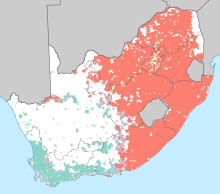 Dominant population groups in South Africa. African Coloured Indian or other Asian White None dominant Little or no population
Ethnic groups South Africa (1911)
Black African (67%) White (21%) Coloured (9%) Asian (3%)
Ethnic groups South Africa (2004)
Black African (79%) White (10%) Coloured (9%) Asian (2%)
Statistics South Africa asks people to describe themselves in the census in terms of five racial population groups.[27] The 2011 census figures for these groups were Black African at 80.2%, White at 8.4%, Coloured at 8.8%, Indian/Asian at 2.5%, and Other/Unspecified at 0.5%.[28]
The white percentage of the population has sharply declined. The first census in South Africa in 1911 showed that whites made up 22% of the population. This declined to 16% in 1980,[29] and 8.9% in 2011.[30]: 21
Languages
South Africa has eleven official languages:[31] IsiZulu[28] 22.7%, IsiXhosa[28] 16%, Afrikaans[28] 13.5%, English[28] 9.6%, Sepedi[28] 9.1%, Setswana[28] 8%, Sesotho[28] 7.6%, Xitsonga[28] 4.5%, SiSwati[28] 2.5%, Tshivenda[28] 2.4% and isiNdebele[28] 2.1%.
In this regard it is third only to Bolivia and India in number. While all the languages are formally equal, some languages are spoken more than others. According to the 2011 census, the three most spoken first languages are Zulu (22.7%), Xhosa (16.0%), and Afrikaans (13.5%).[30]: 23–25 Despite the fact that English is recognised as the language of commerce and science, it ranked fourth, and was spoken by only 9.6% of South Africans as a first language in 2011.[30]: 23–25
The country also recognises several unofficial languages, including Sekholokoe, Fanagalo, Khoe, Lobedu, Nama, Northern Ndebele, Phuthi, San and South African Sign Language.[32] These unofficial languages may be used in certain official uses in limited areas where it has been determined that these languages are prevalent. Nevertheless, their populations are not such that they require nationwide recognition.
Many of the “unofficial languages” of the San and Khoikhoi people contain regional dialects stretching northwards into Namibia and Botswana, and elsewhere. These people, who are a physically distinct population from other Africans, have their own cultural identity based on their hunter-gatherer societies. They have been marginalised to a great extent, and many of their languages are in danger of becoming extinct.
Many white South Africans also speak other European languages, such as Portuguese (also spoken by black Angolans and Mozambicans), German, and Greek, while some Indians and other Asians in South Africa speak South Asian languages, such as Tamil, Hindi, Gujarati, Urdu and Telugu. Although many South Africans are of Huguenot (French) origin, South African French is spoken by fewer than 10,000 individuals country-wide. Congolese French is also spoken in South Africa by migrants.
The primary sign language of deaf South Africans is South African Sign Language. Other sign languages among indigenous peoples are also used.
By ethnicity
In 2011, the first language was Zulu for 28.1% of African residents, Xhosa for 19.8%, Northern Sotho for 11.2%, Tswana for 9.7%, Sesotho for 9.3%, Tsonga for 5.5%, Swati for 3.1%, Venda for 2.9%, English for 2.8%, Southern Ndebele for 2.6%, Afrikaans for 1.5%, while 3.4% had another first language.[33]
Among whites, Afrikaans was the first language for 59.1% of the population, compared to 35.0% for English. Other languages accounted for the remaining 5.9%.[33]
Religion
| Learn more This section needs to be updated. Veuillez aider à mettre à jour cet article pour refléter les événements récents ou les informations nouvellement disponibles. (September 2020) |
Religion in South Africa (2016)[34]
Protestantism (71.2%) Roman Catholicism (6.8%) No religion (10.9%) Traditional African religion (4.4%) Islam (1.6%) Hinduism (1.0%) Judaism (0.1%) Other religions (2.7%) Undetermined (1.4%)
According to the 2001 national census, Christians accounted for 79.7% of the population. This includes Protestant (36.6%), Zionist Christian (11.1%), Pentecostal/Charismatic (8.2%), Roman Catholic (7.1%), Methodist (6.8%), Dutch Reformed (6.7%), Anglican (3.8%); members of other Christian churches accounted for another 36% of the population. Muslims accounted for 1.5% of the population, Other 2.3%, and 1.4% were Unspecified and None 15.1%.[28]
African Indigenous Churches made up the largest of the Christian groups. Some believe that many people claiming no affiliation with any organised religion adhered to traditional indigenous religions. Many people have syncretic religious practices combining Christian and indigenous influences.[35]
Muslims are largely found among the Coloured and Indian ethnic groups. They have been joined by black or white South African converts as well as immigrants from other parts of Africa.[36] South African Muslims claim that their faith is the fastest-growing religion of conversion in the country, with the number of black Muslims growing sixfold, from 12,000 in 1991 to 74,700 in 2004[36][37]
The Hindu population has its roots in the British colonial period, but later waves of immigration from India have also contributed to it. Most Hindus are of South Asian origin, but there are many who come from mixed racial stock. Some are converts due to the efforts of ISKCON.
Other minority religions in South Africa are Sikhism, Jainism, Baháʼí Faith and Judaism.[38]
By ethnicity
87.9% of Black residents are Christian, 9.5% have no religion, 0.2% are Muslim, 0.0% are Jewish, 1.22% are Hindu and 2.3% have other or undetermined beliefs.
71.8% of White residents are Christian, 23.8% have no religion, 0.2% are Muslim, 1.4% are Jewish, and 0.0% are Hindu. 2.7% have other or undetermined beliefs.
Other demographic statistics
Demographic statistics according to the World Population Review in 2019.[39]
- One birth every 27 seconds
- One death every 58 seconds
- One net migrant every 9 minutes
- Net gain of one person every 47 seconds
The following demographic are from the CIA World Factbook[40] unless otherwise indicated.
Population
55,380,210 (July 2018 est.)
Age structure
 Population pyramid of South Africa in 2017 0-14 years: 28.18% (male 7,815,651 /female 7,793,261) 15-24 years: 17.24% (male 4,711,480 /female 4,837,897) 25-54 years: 42.05% (male 11,782,848 /female 11,503,831) 55-64 years: 6.71% (male 1,725,034 /female 1,992,035) 65 years and over: 5.81% (male 1,351,991 /female 1,866,182) (2018 est.)
Median age
total: 27.4 years. Country comparison to the world: 144th male: 27.2 years female: 27.6 years (2018 est.)
Birth rate
19.9 births/1,000 population (2018 est.) Country comparison to the world: 78th
Death rate
9.3 deaths/1,000 population (2018 est.) Country comparison to the world: 57th
Total fertility rate
2.26 children born/woman (2018 est.) Country comparison to the world: 91st
Population growth rate
0.97% (2018 est.) Country comparison to the world: 114th
Contraceptive prevalence rate
54.6% (2016)
Net migration rate
-0.9 migrant(s)/1,000 population (2018 est.) Country comparison to the world: 138th
Dependency ratios
total dependency ratio: 52.5 (2015 est.) youth dependency ratio: 44.8 (2015 est.) elderly dependency ratio: 7.7 (2015 est.) potential support ratio: 12.9 (2015 est.)
Urbanization
urban population: 66.4% of total population (2018) rate of urbanization: 1.97% annual rate of change (2015-20 est.)
Life expectancy at birth
total population: 64.1 years (2018 est.)
Languages
IsiZulu (official) 24.7%, IsiXhosa (official) 15.6%, Afrikaans (official) 12.1%, Sepedi (official) 9.8%, Setswana (official) 8.9%, English (official) 8.4%, Sesotho (official) 8%, Xitsonga (official) 4%, SiSwati (official) 2.6%, Tshivenda (official) 2.5%, Khoi, Nama, and San languages 1.9% isiNdebele (official) 1.6% (2017 est.) note: data represent language spoken most often at home
Education expenditures
6.1% of GDP (2017) Country comparison to the world: 34th
Literacy
definition: age 15 and over can read and write (2015 est.)
total population: 94.4% male: 95.4% female: 95.4% (2015 est.)
School life expectancy (primary to tertiary education)
total: 14 years male: 13 years female: 14 years (2016)
Unemployment, youth ages 15-24
total: 53.5% male: 49.3% female: 58.7% (2017 est.)
Immigration

South Africa hosts a sizeable refugee and asylum seeker population. According to the World Refugee Survey 2008, published by the U.S. Committee for Refugees and Immigrants, this population numbered approximately 144,700 in 2007.[41] Groups of refugees and asylum seekers numbering over 10,000 included people from Zimbabwe (48,400), the Democratic Republic of the Congo (24,800), and Somalia (12,900).[41] These populations mainly lived in Johannesburg, Pretoria, Durban, Cape Town, and Port Elizabeth.[41] Many refugees have now also started to work and live in rural areas in provinces such as Mpumalanga and KwaZulu-Natal.
Statistics SA assumes in some of their calculations that there are fewer than 2 million immigrants in South Africa.[42] Other institutions, like the police and Médecins Sans Frontières place estimate the figure at 4 million.[43][44][45][46][47]
Immigration figures
Immigration assumptions by Statistics South Africa to South Africa based on race. Negative numbers represent net migration from South Africa to other countries.[48]
| Year | African | Asian | White |
|---|---|---|---|
| 1985-2000 | 1 135 275 | 14 476 | -304 112 |
| 2001-2005 | 769 038 | 23 335 | -133 782 |
| 2006-2010 | 922 885 | 34 688 | -112 046 |
| 2011-2015 | 1 067 936 | 40 929 | -95 158 |
Urbanization
“Urban areas contain about two-thirds of the population; many of these consist of huge informal or squatter settlements.”[49]
Largest municipalities
Largest cities or towns in South Africa |
|||||
|---|---|---|---|---|---|
| Rank | Name | Province | Pop. | ||
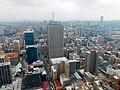 Johannesburg 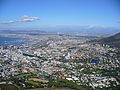 Cape Town |
1 | Johannesburg | Gauteng | 9,167,045 |  Durban 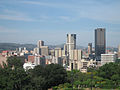 Pretoria |
| 2 | Cape Town | Western Cape | 4,004,793 | ||
| 3 | Durban | KwaZulu-Natal | 3,661,911 | ||
| 4 | Pretoria | Gauteng | 2,437,000 | ||
| 5 | Port Elizabeth | Eastern Cape | 1,263,051 | ||
| 6 | Vereeniging | Gauteng | 957,528 | ||
| 7 | Soshanguve | Gauteng | 841,000 | ||
| 8 | East London | Eastern Cape | 810,528 | ||
| 9 | Bloemfontein | Free State | 759,693 | ||
| 10 | Pietermaritzburg | KwaZulu-Natal | 679,766 |
Graphs and maps
-

Population pyramid by population group, 2011
-

Black South African(African) population
-

White population
-

Coloured population


See also
- Statistics South Africa
- South African National Census of 2001
- South African National Census of 2011
- Afrikaans-speaking population of South Africa
- Jewish population of South Africa
- Ethnic groups in South Africa by municipality
References
- ^ a b Africa, Statistics South. “SA population reaches 58,8 million | Statistics South Africa”. Archived from the original on 1 February 2020. Retrieved 7 March 2020.
- ^ a b “Mid – year population estimates” (PDF). Stats SA. Statistics South Africa. 23 July 2018. Archived from the original (PDF) on 23 July 2018. Retrieved 23 July 2018.
- ^ a b “World Development Indicators | The World Bank”. wdi.worldbank.org. Retrieved 15 June 2020.
- ^ “Census 2021 New Methodologies Test”. Statistics South Africa (Stats SA). 20 July 2018. Archived from the original on 4 August 2018.
- ^ “Table 3.5, Statistical release (Revised) P0301.4, Census 2011” (PDF). Statssa.gov.za. Archived from the original (PDF) on 13 November 2015. Retrieved 25 July 2016.
- ^ “Nowhere left to go”. The Economist. 20 May 2008. Retrieved 29 August 2017.
- ^ “Escape From Mugabe: Zimbabwe’s Exodus”. Archived from the original on 24 January 2016.
- ^ Ogura, Mitsuo (1996). “Urbanization and Apartheid in South Africa: Influx Controls and Their Abolition”. The Developing Economies. 34 (4): 402–423. doi:10.1111/j.1746-1049.1996.tb01178.x. ISSN 1746-1049.
- ^ a b Smuts I: The Sanguine Years 1870–1919, W.K. Hancock, Cambridge University Press, 1962, pg 219
- ^ The Statesman’s Year-Book, 1967–1968 (104th annual edition), edited by S.H. Steinberg, Macmillan, London; St. Martin’s Press, New York, 1967, pages 1405–1424
- ^ The Europa Year Book 1969, Volume II: Africa, The Americas, Asia, Australasia, Europa Publications, London, 1969, page 1286
- ^ Statistics South Africa (1999). “The People of South Africa: Population Census, 1996” (PDF). Retrieved 19 April 2020.
- ^ Statistics South Africa (2003). “Statistics South Africa: Census 2001” (PDF). Retrieved 20 April 2020.
- ^ Statistics South Africa (2012). “Census 2011: Census in Brief” (PDF). Retrieved 20 April 2020.
- ^ Angus Maddison (2010). “Statistics on World Population, GDP and Per Capita GDP, 1-2008 AD”. University of Groningen. Retrieved 1 March 2016.
- ^ The Statesman’s Year-Book 1977–1978 (ed. John Paxton), St. Martin’s Press, New York (& Macmillan, London), 1977, page 1296
- ^ “City of Cape Town / Isixeko Sasekapa, Stad Kaapstad: Metropolitan Municipality & Main Places – Statistics & Maps on City Population”. Citypopulation.de. Archived from the original on 29 August 2017. Retrieved 29 August 2017.
- ^ “South Africa: Provinces and Major Urban Areas – Population Statistics in Maps and Charts”. Citypopulation.de. Retrieved 29 August 2017.
- ^ Population Division of the Department of Economic and Social Affairs of the United Nations Secretariat (2015). “Total Population – Both Sexes (XLS, 3.74 MB) – 2015 revision”. United Nations. Archived from the original on 22 December 2015. Retrieved 1 March 2016.
- ^ “Mid-year population estimates” (PDF). Statistics South Africa. 23 July 2015. Retrieved 1 March 2016.
- ^ “World Population Prospects 2019: Data Booklet” (PDF). United Nations Department of Economic and Social Affairs Population Dynamics. Archived from the original (PDF) on 12 February 2020. Retrieved 21 March 2020.
- ^ a b Population Division of the Department of Economic and Social Affairs of the United Nations Secretariat, World Population Prospects: The 2019 Revision Archived 17 June 2020 at the Wayback Machine
- ^ “Archived publications for: P0302”. www.statssa.gov.za. Retrieved 19 April 2020.
- ^ http://www.statssa.gov.za/publications/P0302/P03022020.pdf[bare URL PDF]
- ^ “The DHS Program – Quality information to plan, monitor and improve population, health, and nutrition programs”. Dhsprogram.com. Retrieved 29 August 2017.
- ^ “World Population Prospects – Population Division – United Nations”. Archived from the original on 19 September 2016. Retrieved 15 July 2017.
- ^ Lehohla, Pali (5 May 2005). “Debate over race and censuses not peculiar to SA”. Business Report. Archived from the original on 14 August 2007. Retrieved 25 August 2013. Others pointed out that the repeal of the Population Registration Act in 1991 removed any legal basis for specifying ‘race’. The Identification Act of 1997 makes no mention of race. On the other hand, the Employment Equity Act speaks of ‘designated groups’ being ‘black people, women and people with disabilities’. The Act defines ‘black’ as referring to ‘Africans, coloureds and Indians’. Apartheid and the racial identification which underpinned it explicitly linked race with differential access to resources and power. If the post-apartheid order was committed to remedying this, race would have to be included in surveys and censuses, so that progress in eradicating the consequences of apartheid could be measured and monitored. This was the reasoning that led to a ‘self-identifying’ question about ‘race’ or ‘population group’ in both the 1996 and 2001 population censuses, and in Statistics SA’s household survey programme.
- ^ a b c d e f g h i j k l m “Africa :: SOUTH AFRICA”. CIA The World Factbook.
- ^ Study Commission on U.S. Policy toward Southern Africa (U.S.) (1981). South Africa: time running out : the report of the Study Commission on U.S. Policy Toward Southern Africa. University of California Press. p. 42. ISBN 0-520-04547-5. {{cite book}}: |author= has generic name (help)
- ^ a b c Census 2011: Census in brief (PDF). Pretoria: Statistics South Africa. 2012. ISBN 9780621413885.
- ^ “Constitution of South Africa, Chapter 1, Section 6”. Fs.gov.za. Archived from the original on 29 July 2009. Retrieved 30 May 2010.
- ^ “The languages of South Africa”. Media Club South Africa. Brand South Africa. December 2011. Archived from the original on 1 December 2017. Retrieved 24 November 2017.
- ^ a b “Community profiles > Census 2011”. Statistics South Africa Superweb. Archived from the original on 30 September 2013. Retrieved 21 August 2013.
- ^ “South Africa – Community Survey 2016”. www.datafirst.uct.ac.za. Retrieved 25 November 2018.
- ^ “South Africa”. State.gov. Retrieved 29 August 2017.
- ^ a b “In South Africa, many blacks convert to Islam”. Christian Science Monitor. 10 January 2002. Retrieved 29 August 2017.
- ^ “Muslims say their faith growing fast in Africa”. Religionnewsblog.com. 15 November 2004. Retrieved 7 November 2010.
- ^ “South Africa – Section I. Religious Demography”. U.S. Department of State. Retrieved 15 July 2006.
- ^ “South Africa Population 2019”, World Population Review, archived from the original on 3 April 2019, retrieved 6 April 2019
- ^ “The World FactBook – South Africa”, The World Factbook, 12 July 2018
 This article incorporates text from this source, which is in the public domain .
 - ^ a b c “World Refugee Survey 2008”. U.S. Committee for Refugees and Immigrants. 19 June 2008. Archived from the original on 5 October 2007.
- ^ “P03022009_6”. Statssa.gov.za. Archived from the original on 5 August 2012. Retrieved 5 January 2014.
- ^ So where are Zimbabweans going?, BBC News. 8 November 2005.
- ^ SA population may be much larger than previously thought Beeld 1 June 2009.
- ^ “Archived copy”. Archived from the original on 18 September 2010. Retrieved 6 February 2016.{{cite web}}: Maint CS1 : copie archivée comme titre ( lien )
- ^ South African Police Service 2009 Annual Report Archived 25 July 2013 at the Wayback Machine page 9 indicating the number exceeds 3 million
- ^ [1][dead link]
- ^ “Mid-year population estimates 2014” (PDF). Statistics South Africa. 31 July 2014. Retrieved 8 December 2015.
- ^ “South Africa: Settlement Patterns”. Britannica.com. Retrieved 25 October 2017.
- ^ “Community Survey 2016: Provinces at a Glance” (PDF). Statistics South Africa. Retrieved 29 April 2019.
- ^ United Nations, Department of Economic and Social Affairs, Population Division (2018). “World Urbanization Prospects: The 2018 Revision, Online Edition”. Retrieved 28 April 2019.

Further reading
- Alexandre, Mary (30 juin 2006). « Noir, blanc – ou sud-africain ? . SAinfo. Archivé de l’original le 4 juillet 2006 . Récupéré le 26 juin 2013 .
- “Une nation en devenir: un document de discussion sur les tendances macro-sociales en Afrique du Sud” (PDF) . Gouvernement d’Afrique du Sud. 2006. Archivé de l’original (PDF) le 11 juillet 2006 . Récupéré le 26 juin 2013 .
Liens externes
| Wikimedia Commons a des médias liés à la démographie de l’Afrique du Sud . |
| Wikiquote a des citations liées aux Sud-Africains . |
- Article du Sunday Standard sur la crise des réfugiés au Zimbabwe
- Contient des informations sur la classe moyenne sud-africaine
- Classe moyenne en Afrique du Sud – Importance, rôle et impact